Why Does Bishop Arts Feel Like Its Own Little World Inside Dallas?
Cliff Freeman, Jr. August 12, 2026
Cliff Freeman, Jr. August 12, 2026
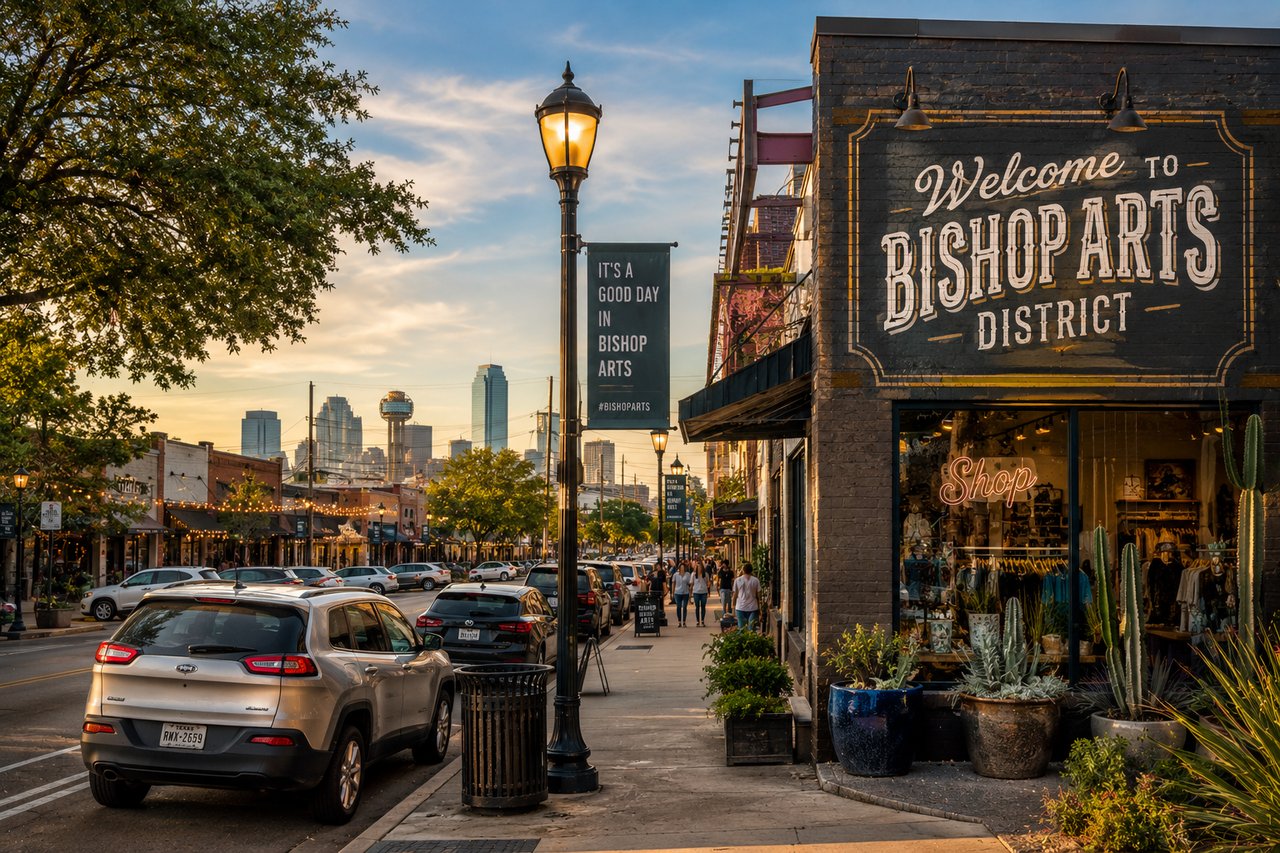
Just southwest of Downtown Dallas in North Oak Cliff, the Bishop Arts District feels like a pocket of the city that decided to do things its own way.
The streets are smaller. The buildings sit closer together. Independent restaurants and shops fill spaces that don't look like they were designed by the same developer. Step a few blocks away, and you'll find older homes beneath mature trees instead of rows of new construction.
That's a big part of the appeal.
Bishop Arts isn't polished in the same way as some of North Texas' newer destinations, and that's exactly why people remember it. It feels specific to Dallas, and more specifically, to Oak Cliff.
Bishop Arts is located in North Oak Cliff, southwest of Downtown Dallas and just across the Trinity River from the city's urban core.
The commercial district itself is relatively compact, centered around Bishop Avenue and Davis Street, but when people talk about living near Bishop Arts, they're often talking about the surrounding Oak Cliff neighborhoods as well.
And that distinction matters.
Bishop Arts isn't a master planned community with a clear entrance where everything suddenly changes. It's part of a much older section of Dallas, where commercial blocks, historic homes, newer development, apartments, parks, and neighborhood streets have grown together over time.
You can feel that history when you're there.
This might be the easiest way to explain Bishop Arts.
You don't necessarily need a reason to go.
You can meet someone for coffee, walk a few blocks, notice a store you've never seen before, stop for lunch, and somehow still be there two hours later.
That's harder to find in DFW than it sounds.
North Texas is built around the car. We drive to dinner. We drive somewhere else for shopping. Then we drive somewhere else again for coffee.
Bishop Arts breaks that routine a little.
Once you're there, walking becomes part of the experience.
And for buyers who have been looking through neighborhoods where nearly every errand starts by getting into the car, that can feel surprisingly refreshing.
Bishop Arts doesn't feel like someone designed an entire neighborhood at once.
Because they didn't.
Buildings are different ages. Storefronts don't all match. Streets change character from one block to another. Older homes sit alongside renovations and newer construction.
There's personality in that mix.
There's also a tradeoff.
If you want perfectly uniform streets, predictable lot sizes, brand new infrastructure, and a long list of community amenities, this probably isn't the experience you're looking for.
But buyers interested in Bishop Arts usually aren't looking for perfect uniformity.
They're looking for a place that feels like it already had a life before they arrived.
Spend enough time looking at North Texas real estate and new construction can start to blur together.
Oak Cliff gives you something else.
Around Bishop Arts, you'll find neighborhoods with Craftsman homes, bungalows, Tudor influences, cottages, and properties that have been updated in very different ways over the years.
That variety means buying here requires a different eye.
One beautifully renovated older home may have exactly the character someone wants. Another may come with projects a buyer has no interest in taking on.
That's why comparing two homes near Bishop Arts purely by square footage doesn't tell you much.
Here, the details matter.
So does the block.
There are plenty of places in Dallas where you already know what restaurants and stores you'll find before you arrive.
Bishop Arts has historically built much of its identity around smaller, independent businesses.
That changes how the area feels.
You notice storefronts.
You remember where you had dinner.
You develop a favorite coffee spot.
You recognize places instead of simply recognizing brands.
The neighborhood has certainly become more popular and more developed over the years, so the Bishop Arts of today isn't some untouched secret corner of Dallas.
But it has held onto enough of its local personality that spending an evening here still feels different from spending one in a large shopping development.
Part of Bishop Arts' appeal is that this character doesn't require moving far outside the city.
Downtown Dallas is just across the river.
That gives residents access to major employment centers, entertainment, restaurants, and the rest of central Dallas while still coming home to streets that feel more residential.
For someone relocating to DFW, that can challenge the assumption that getting neighborhood character automatically means giving up proximity to the city.
You don't have to choose between a suburban subdivision and a downtown high rise.
Dallas has options in between.
Bishop Arts is one of them.
If you're seriously considering living near Bishop Arts, visit when people are actually out.
A quiet weekday showing won't tell you the whole story.
Come back on a Saturday.
Walk through the district. Get lunch. Pay attention to parking. Drive through the surrounding residential streets. Notice how quickly the atmosphere changes once you move away from the main commercial blocks.
That last part is important.
Living near Bishop Arts and living directly in the middle of its activity can be two very different experiences.
One buyer may love being able to walk out the door and immediately be part of everything.
Another may want the restaurants and shops nearby, but prefer a quieter street a few minutes away.
Neither is the better choice.
They're just different versions of living around Bishop Arts.
Some buyers arrive and understand the appeal almost immediately.
They care about architecture.
They like independent restaurants.
They'd rather have a neighborhood with some quirks than one where every street looks perfect.
They want to be close to Dallas, and they actually plan to use the places around them.
Other buyers may tour the area and decide they'd rather have a larger home, newer construction, more predictable parking, or the amenities of a master planned community.
That's useful information too.
A neighborhood doesn't need to work for everyone to be a good neighborhood.
It needs to work for the person buying the house.
Bishop Arts feels like its own little world because it doesn't behave like much of Dallas.
It's compact where the Metroplex tends to spread out.
It's walkable where driving is usually the default.
Its buildings and homes don't all match.
Its personality comes from years of change rather than one development plan.
And you're still only a short distance from Downtown Dallas.
That combination isn't going to appeal to every buyer.
But if you've been searching around DFW and everything is starting to feel a little too similar, spending an afternoon in Bishop Arts can remind you just how many different versions of Dallas actually exist.
The Bishop Arts District is located in North Oak Cliff, southwest of Downtown Dallas, primarily around Bishop Avenue and Davis Street.
The core Bishop Arts commercial district is one of the more walkable pockets of Dallas, with restaurants, shops, coffee spots, and other businesses concentrated within a relatively small area. Walkability can vary once you move into the surrounding residential neighborhoods.
Housing varies considerably around Bishop Arts and North Oak Cliff. Buyers can find older Craftsman homes, bungalows, cottages, renovated properties, and newer construction depending on the specific neighborhood and street.
Yes. Bishop Arts is located just southwest of Downtown Dallas, across the Trinity River, which is one reason buyers who want neighborhood character without moving far from central Dallas often consider the area.
It can be, particularly for buyers who value walkability, local restaurants and businesses, older architecture, and proximity to central Dallas. Buyers who prioritize newer construction, larger lots, or master planned amenities may prefer other parts of DFW.
Stay up to date on the latest real estate trends.
DFW Real Estate

Dallas Real Estate
DFW Real Estate
McKinney TX Real Estate

DFW Real Estate

North Texas Real Estate
Market Reports & Local Trends
North Texas Market Insights
Local Market Insights & Analytics
Find out why our clients and our team of expert agents are the happiest in the Dallas-Fort Worth Metroplex. We are thrilled to have the opportunity to work with you!