How Much Should You Really Offer Below Asking Price on a Home in DFW?
Cliff Freeman, Jr. August 28, 2026
Cliff Freeman, Jr. August 28, 2026
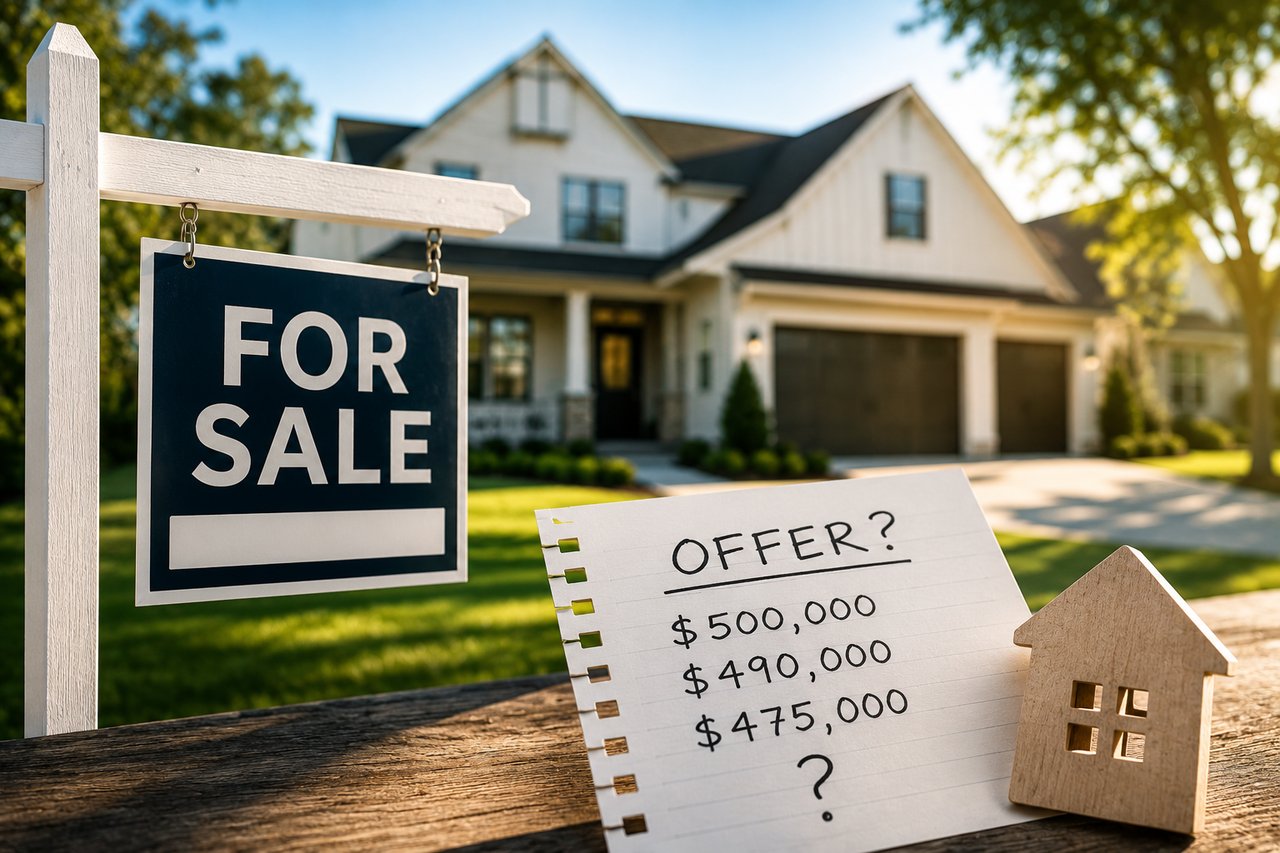
You find a DFW home listed at $500,000.
You like it.
But then you notice it's been sitting for 48 days.
So naturally, you start doing the math.
Could we offer $490,000?
What about $475,000?
Could we try $450,000 and see what happens?
This is where buyers can get themselves into trouble, because there's a big difference between negotiating and simply picking a lower number.
In August 2026, buyers do have negotiating opportunities in DFW. Recent data shows 28.3% of active listings have had a price reduction, and homes are spending a median 54 days on the market. At the same time, active inventory is actually 6.5% lower than it was a year ago.
In other words, this isn't a market where every seller holds all the cards.
But it isn't a market where every buyer can throw out a low offer and expect the seller to take it either.
The right offer depends on the house in front of you.
You'll hear rules like this all the time.
Always start 5% below asking.
Always offer 10% less.
Never pay list price.
If it's been sitting 30 days, take $20,000 off.
Real estate doesn't work that neatly.
Imagine two houses listed for $500,000.
One is actually worth around $525,000 based on recent comparable sales, and the seller intentionally priced it aggressively.
The other is worth closer to $475,000, but the seller started high because they wanted to “see what happens.”
Same asking price.
Completely different offer strategy.
That's why the first question shouldn't be:
“How much below asking should we offer?”
It should be:
“What does this house appear to be worth?”
This sounds obvious, but buyers forget it all the time.
A seller can ask whatever they want.
$450,000.
$500,000.
$600,000.
That doesn't make the house worth that amount.
The asking price is a marketing decision.
Sometimes it's right on the money.
Sometimes it's intentionally attractive to generate attention.
Sometimes it's optimistic.
And sometimes the market has already spent six weeks telling the seller they're too high.
Before deciding what to offer, look at what similar homes have actually sold for.
Not what they're listed for.
Sold for.
That's where the conversation gets more useful.
Let's say a home is listed for $500,000.
Your agent looks at recent comparable sales and finds similar homes nearby closing between $480,000 and $490,000.
Now an offer around $485,000 doesn't look like a random lowball.
There's an argument behind it.
But suppose those same comparable homes have been closing between $510,000 and $520,000.
Suddenly $500,000 may already be an attractive price.
Offering $475,000 simply because you want a discount could mean losing a good opportunity.
That's why good negotiation starts with information.
You're not trying to prove that the seller is wrong.
You're trying to understand where the market is.
This is one of the first things we'd look at.
A home listed yesterday and a home listed 75 days ago should not automatically receive the same offer strategy.
When a property first hits the market, the seller may still be confident.
They haven't had much buyer feedback.
They may be expecting additional showings.
They may even have other offers.
After two months?
They know a lot more.
Maybe they've had plenty of showings but no offers.
Maybe buyers keep saying the same thing about the price.
Maybe the seller has already moved.
Maybe they're carrying two housing payments.
Maybe nothing is wrong at all, and they're perfectly willing to wait.
You don't know until you start digging.
But time on market gives you something to investigate.
And right now, that matters in DFW. The latest available data shows homes spending a median 54 days on market, slightly longer than a year earlier.
This is where buyers sometimes get a little too excited.
A house was originally listed for $550,000.
Now it's $500,000.
The buyer thinks:
“They already dropped $50,000. Let's offer $475,000.”
Maybe.
But the previous $550,000 price doesn't tell us the home is now worth less than $500,000.
What if $550,000 was simply unrealistic?
What if comparable sales support $500,000?
The seller may have finally corrected the price.
That doesn't necessarily mean they're ready to negotiate another $25,000.
This is particularly relevant in the current market because price adjustments are common. In July, 28.3% of DFW listings had experienced a price reduction, one of the higher rates among major U.S. metros.
A price cut is useful information.
It isn't automatic permission for another one.
There's another thing happening in 2026 that's worth noticing.
Sellers nationally have become more realistic about pricing from the beginning. Recent Realtor.com research found that sellers are adjusting to softer conditions rather than repeatedly chasing the market downward with one price cut after another.
That changes how buyers should read reductions.
A price cut doesn't always mean:
“This seller is desperate.”
Sometimes it means:
“The seller finally brought the house to where buyers think it should be.”
Those are very different situations.
Let's use a few hypothetical examples.
The house is updated.
Recent comparable sales support roughly $500,000.
There have been plenty of showings and another buyer may be preparing an offer.
Offering $450,000 probably isn't clever negotiating.
You're just making it easier for the seller to work with someone else.
Depending on the property, even $485,000 might be unnecessarily aggressive.
Comparable homes have recently closed around $480,000 to $490,000.
The seller hasn't adjusted the price.
There's no competing offer.
Now an offer somewhere in that range has a logical foundation.
You're not choosing a random discount.
You're responding to what the market has been saying.
The home has been on the market for 50 days.
Recent comparable sales support approximately $490,000 to $500,000.
This is where buyers sometimes make the mistake of focusing on the original price.
The seller already made the adjustment.
If $490,000 is now supported by the market, another large discount may not make sense.
Comparable updated homes sell around $500,000.
But this one needs flooring, paint, an older HVAC system replaced, and significant cosmetic updates.
Now we have something else to evaluate.
How much does the condition actually affect what buyers are willing to pay?
That's a better conversation than simply saying:
“Let's offer 10% less.”
This deserves its own section.
Buyers walk into a house and start mentally subtracting.
$15,000 for the kitchen.
$10,000 for floors.
$8,000 for paint.
$20,000 because you hate the bathrooms.
Suddenly a $500,000 house is “worth” $447,000.
Not necessarily.
Your personal renovation budget isn't automatically the seller's price reduction.
The real question is how the market treats homes in that condition.
If renovated homes are selling for $525,000 and similar unrenovated ones are closing around $480,000, now we have useful evidence.
That's different from subtracting the cost of everything you'd personally change.
You can.
There's no law saying you can't offer $450,000 on a $500,000 house.
But there can be consequences.
The seller might reject it.
They might counter.
Or they might decide you're not a serious buyer and become less interested in negotiating with you.
This matters particularly when you actually love the house.
If you'd be completely fine losing it, an aggressive offer may be a risk you're willing to take.
But if you'd be upset tomorrow because someone else bought it for $485,000 while you offered $450,000?
That's different.
Your negotiating strategy should reflect how badly you want the property.
DFW is giving some buyers more room than they had during the most competitive years.
But the market is mixed.
The latest data shows 29,742 active listings across DFW, down 6.5% year over year, while the median list price remained essentially flat at approximately $439,000.
Texas Real Estate Research Center also describes DFW as a market in transition, with Dallas area price declines moderating and Fort Worth Arlington recently posting year over year price gains.
That's not a collapsing market.
It's also not a market where every seller can name their price.
The result is something less dramatic and more useful:
You have to evaluate the individual deal.
This connects directly with something buyers often overlook.
Maybe the seller won't take $20,000 off.
But would they contribute toward eligible closing costs?
Would they consider a mortgage rate buydown?
Would they address an inspection item?
Would they include something with the property?
Would they agree to a closing timeline that works better for you?
The purchase price is important.
It's not the only negotiable part of a real estate transaction.
Sometimes fighting over the last $5,000 of purchase price isn't where the biggest benefit is.
That's why the question shouldn't always be:
“How low can we get them?”
Sometimes it's:
“What can we negotiate that actually helps us most?”
Then forget most of what you just read.
Not literally.
But the strategy changes.
If three buyers want the same property, the seller has leverage that they didn't have when the home was sitting without an offer.
Now you have to decide how much the property is worth to you, while still making sure the price makes sense.
You don't automatically need to offer above asking.
You also shouldn't assume you can come in 5% below and still have a realistic shot.
This is why market conditions aren't enough.
Competition for the individual home matters.
There isn't an official percentage.
A lowball offer is really an offer that is difficult to support based on the property, comparable sales, condition, and current negotiating situation.
$25,000 below asking could be completely reasonable on one house.
$10,000 below asking could be unrealistic on another.
If you can explain your offer using actual market evidence, you probably have a stronger position.
If the explanation is:
“We just wanted to see if they'd take it,”
then you're taking a gamble.
Sometimes gambles work.
Just understand that's what you're doing.
This is probably the biggest thing we'd want buyers to take away.
Getting a house for $20,000 under asking doesn't automatically mean you got a great deal.
What if it was overpriced by $40,000?
And paying asking price doesn't automatically mean you overpaid.
What if the seller intentionally listed below recent comparable sales?
The number that matters isn't the difference between asking price and purchase price.
It's the relationship between purchase price and actual market value.
That's the number buyers should care about.
Start here.
Look at recent comparable sales.
Look at how long the home has been listed.
Look at previous price adjustments.
Look at the condition.
Find out whether there are other offers.
Look at what's happening in that specific neighborhood and price range.
Then ask yourself one more question:
How disappointed would I be if someone else bought this house for slightly more than I'm offering?
That question matters more than people think.
Because negotiation isn't about winning an argument with the seller.
It's about getting the right house at a price and on terms that still make sense for you.
So, how much below asking should you offer on a home in DFW?
Maybe nothing.
Maybe $10,000.
Maybe $25,000.
Maybe considerably more.
There's no honest percentage we can give you without looking at the property.
And anyone telling buyers to automatically offer 5% or 10% below every listing is ignoring how different one DFW home can be from the next.
In August 2026, there are real negotiating opportunities. Price reductions remain common, homes are taking a little longer to sell, and some sellers are clearly willing to adjust. But DFW inventory is also tighter than it was a year ago, and well priced homes can still attract serious competition.
So don't make an offer because you want to say you got the house “under asking.”
Figure out what the home is actually worth.
Figure out what leverage you actually have.
And then make an offer you'd still feel good about if the seller accepted it five minutes later.
That's a much better way to buy a house.
There is no standard percentage. The appropriate offer depends on comparable sales, condition, days on market, previous price reductions, competition, and local market conditions. A percentage that makes sense for one property may be completely inappropriate for another.
Sometimes, but not always. If a property is significantly overpriced or comparable sales support the lower number, a 10% difference could potentially be justified. On a properly priced home with strong buyer interest, it could make the offer uncompetitive.
Yes. Buyers can offer whatever amount they choose, and current DFW conditions are creating negotiating opportunities on some properties. However, 28.3% of active DFW listings recently had a price reduction while inventory remained 6.5% below last year, so leverage varies considerably from one property to another.
Not necessarily. A reduction may indicate seller flexibility, but it may also mean the home was originally overpriced and has now been brought closer to market value. Comparable sales and the property's response after the reduction provide more useful information.
It can. A property that has been available substantially longer than comparable homes may give buyers more reason to explore negotiation. However, days on market alone doesn't reveal the seller's motivation or determine the property's value.
Possibly. If comparable sales support the asking price and there is meaningful buyer competition, offering below asking simply for the sake of negotiating could weaken your position. The goal should be to pay a price that makes sense for the property, not necessarily to finish below the number on the listing.
If you've found a home and you're wondering what you should actually offer, the answer shouldn't come from a generic percentage.
The Cliff Freeman Group can help you look at the property, recent comparable sales, neighborhood conditions, and the seller's position before deciding how to structure your offer.
Explore more DFW real estate insights:
TCFG Blog: tcfg.homes/dfw-blog
Have questions about buying or selling in DFW?
Call The Cliff Freeman Group at 469-936-4377
Stay up to date on the latest real estate trends.
Dallas Real Estate
DFW Real Estate

Dallas Real Estate
DFW Real Estate

McKinney TX Real Estate
DFW Real Estate

North Texas Real Estate
Market Reports & Local Trends
North Texas Market Insights
Find out why our clients and our team of expert agents are the happiest in the Dallas-Fort Worth Metroplex. We are thrilled to have the opportunity to work with you!